Photographing Qingdao rarely fails because of the camera. It fails because people arrive when the light is wrong. At the same viewpoint, forty minutes early and forty minutes late produce two entirely different pictures. The usual regrets are arriving to find the sun behind you, crowds blocking the foreground, or the tide sitting at its least flattering point. Shandong JunYue International Travel Agency has handled Shandong ground arrangements for more than ten years, including camera clubs, family portrait trips and corporate photo groups. The tables below set out the four core viewpoints used most often, expressed as time windows rather than clock times, since the usable light shifts with the season.
1. Four viewpoints and their windows
| Viewpoint | Best window | Light direction | Focal length and frame | On site notes |
|---|---|---|---|---|
| Xiaoyushan hilltop | Late morning 8-10 or the 60-90 minutes before sunset | Soft front-to-side light in the morning, warm low sun in the evening | Standard lens for red roofs and canopy layers; short telephoto to compress the curve of the bay | The platform is small; tripod space is limited, so follow whatever the site allows on the day |
| Zhanqiao pier and Huilan Pavilion | Arrive 30-40 minutes before sunrise, or 20-30 minutes after sunset | Warm frontal light at sunrise; backlit silhouettes in the evening | Wide angle for the leading line of the pier; short telephoto to compress pavilion against sea | Crowds restrict composition mid-morning; wind affects stability and footing |
| Badaguan streets | Late morning, around 9-11 | Side light reveals facade modelling and street depth | Short telephoto to compress the avenue; avoid extreme wide-angle distortion | Parts of the district are heritage areas; commercial shoots and supports follow the site's current rules |
| Olympic Sailing Centre and Lover's Dam | From 60-90 minutes before sunset into blue hour | Backlight and blue hour produce the strongest results | Wide angle for masts and the breakwater line; telephoto to pull in the skyline | Strong sea wind and wet surfaces; night contrast is high, so use a release or timer |
The way to read this table is to locate the sun first, then choose your side. With the sun behind you, water and sky render warm and saturated; shooting into the sun gives silhouettes and layered cloud. Huilan Pavilion at Zhanqiao works best late in the day: once the sun drops behind the structure, the outline separates naturally against the sky, which flat midday light cannot do.
2. Season and weather: the same spot, different moods
| Condition | What it suits | How to adjust | Reminder |
|---|---|---|---|
| Clear and transparent | Warm sunrise and sunset tones, distant outlines | Pull exposure down slightly to hold detail in the sky | Midday contrast is too harsh; schedule meals and transfers instead |
| Haze or overcast | Soft portraits, building detail, street texture | Contrast is low, so add a little in processing; haze suits layered distance | When visibility drops, abandon wide views and shoot close detail |
| Strong coastal wind | Wave action and movement in the sea | Fast shutter to freeze spray, or slow shutter for mist-like water with firm support | Change lenses with your back to the wind to keep salt and sand out |
| Just after rain | Wet street reflections, broken cloud light | Use standing water as foreground reflection | Rocks are slippery; move slowly |
| Autumn and winter | Long shadows from the low sun | The sun stays low, so side-light hours last longer than in summer | Wind chill is real on the coast; keep hands warm and spare batteries close to the body |
3. Tides and routing: the two things photo groups should calculate first
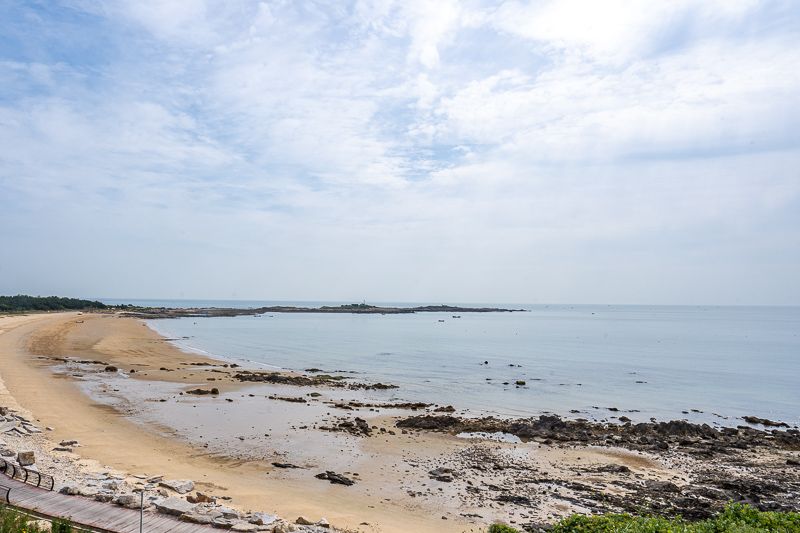
First, the tide decides whether rocky foregrounds can be reached and whether they look good. At high tide the frame is clean and water colour even; at low tide rocks and sand flats appear, adding depth but also changing where it is safe to stand. Check the tide table in advance and allow time to walk back before the water returns. No composition is worth being cut off by a rising tide.
Second, sequence stops by light direction, not by distance. A workable day faces east for sunrise, moves to front-lit streets or hilltops in the morning, takes lunch and a long transfer around midday, then returns to a west-facing or open coastline for sunset and blue hour. Sequencing by map distance tends to put you at your most important viewpoint during the worst light of the day.
Third, budget time simply to wait for light. Gaps in cloud often open for only a few minutes. Leaving slack in the plan usually yields more usable frames than squeezing in one more stop. Shandong JunYue International Travel Agency generally limits a photo day to three or four viewpoints and spends the remaining time waiting and repositioning, which measurably raises the keep rate.
1. Choosing a viewpoint before checking where the sun will be - direction beats equipment every time.
2. Arriving at sunrise rather than thirty minutes earlier, and missing the transition light.
3. Assuming tripods and drones are fine everywhere; coastal viewpoints, heritage zones and crowded areas apply their own rules as published at the time.
4. Shooting from wet rocks while the tide turns - leave a margin and prioritise safety.
5. Changing lenses facing the sea wind - turn away, shield the body, and wipe gear down before it goes back in the bag.
4. Questions
Q1. Which Qingdao viewpoint is the safest choice for a first visit?
Start with Xiaoyushan and Zhanqiao. Xiaoyushan sits high enough to frame red roofs, tree canopy and the bay in one image, and it demands least from your gear. Zhanqiao is Qingdao's strongest visual signature and is quietest early in the morning and after sunset. The two are close together, so a single morning can cover both.
Q2. What time of day suits Badaguan?
Late morning, roughly between nine and eleven, when side light reveals the turn of building facades and the depth of tree-lined streets. Midday light is hard and contrasty. Use a short telephoto to compress narrow streets rather than a wide lens that exaggerates perspective.
Q3. How early should I arrive for a seaside sunrise?
Plan to be in position thirty to forty minutes before sunrise. The most photogenic moments often come during the cool-to-warm transition before the sun clears the horizon. Scout the foreground and horizon line first instead of hunting for a spot at the last minute.
Q4. How much does the tide affect seaside compositions?
A great deal. High tide gives clean, uniform water; low tide exposes rocks and sand flats that add foreground depth but also changes where you can safely stand. Check the tide table for the day and leave enough margin to walk back before the water returns.
Q5. Can I use a tripod or drone anywhere I like?
No. Some coastal viewpoints, heritage building zones and crowded public areas apply their own rules to tripods, drones and commercial shooting, and these follow whatever the site publishes at the time. Check before you go, follow instructions on site, and fall back to handheld shooting if support is not permitted. Itineraries can be arranged at +86 13953211866 or WeChat 813556.
The whole approach reduces to one line: calculate the sun, then the tide, then be patient. Shandong JunYue International Travel Agency builds photo itineraries around seasonal light and the day's tide table, including vehicle support and transfer timing, so the limited good hours land on the right viewpoints. Enquiries at +86 13953211866 or WeChat 813556.